



In building decoration and computer room construction, calcium sulfate floor panels are commonly chosen, but there is a clear difference between anti-static raised floors and general raised floors due to their different functional purposes. Here, we examine the differences between the two from five key aspects.
From the definition perspective, the core distinction lies in the "anti-static" function. Calcium sulfate anti-static raised floors use high-strength calcium sulfate as the base material, with HPL or PVC anti-static surfaces, reinforced with galvanized steel on the bottom, and black PVC edge trim around the sides; anti-static performance is the core attribute. In contrast, calcium sulfate raised floors (also known as fully encased steel-calcium sulfate network floors) are made by enclosing high-density calcium sulfate material between two layers of galvanized steel, focusing on the "raised" function without anti-static surfaces.
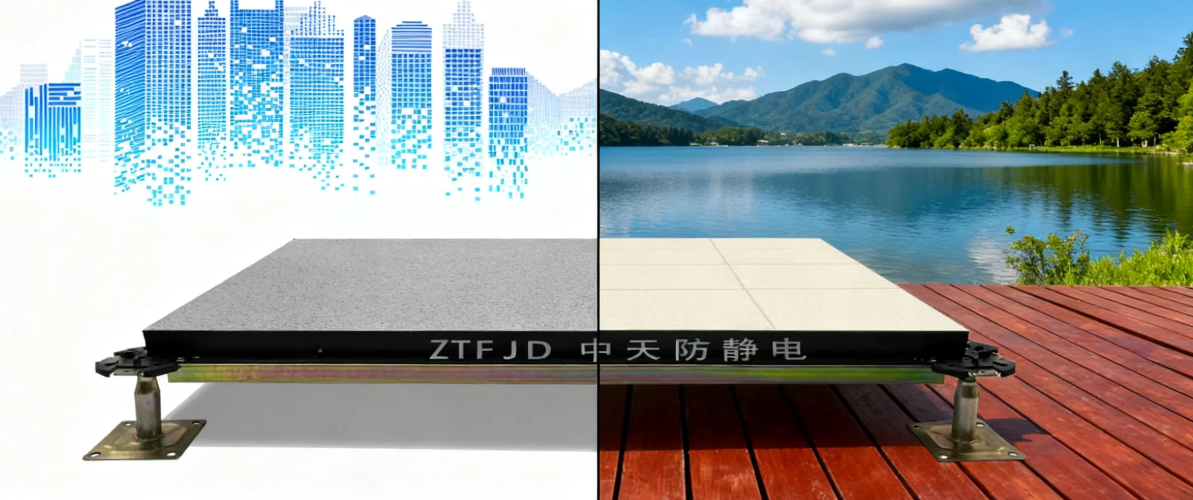
In terms of specifications and performance, sizes and load-bearing capabilities differ. Common sizes for anti-static raised floors are 600x600x30mm, 600x600x32mm, and 600x600x40mm, with a load capacity of up to 16,680N, uniform load range of 16,500-33,000N, and system resistance meeting anti-static standards of 1×10^6~1×10^10Ω. Raised floors typically come in sizes 600x600x25mm and 600x600x30mm, with even stronger load capacity, up to 16,797N, and a uniform load range of 23,294-33,084N, without the requirement for anti-static resistance.
In terms of usage performance, the two share some characteristics and also have differences. Both offer fireproofing, waterproofing, thermal insulation, non-combustibility, sound insulation, long service life, and recyclability. However, anti-static raised floors additionally provide stable anti-static performance, while raised floors focus more on the stability of the raised support.Differences in application fields stem from functional purposes. Anti-static raised floors, due to their anti-static properties, are widely used in telecommunications rooms, computer rooms, power dispatch rooms, cleanrooms, and other locations requiring high anti-static requirements. Raised floors, on the other hand, due to their raised function, are suitable for smart office buildings, conference rooms, classrooms, hotels, and other places that need hidden conduits and convenient wiring.
Finally, regarding installation procedures, anti-static raised floors require a combination of floor panels, beams, supports, and copper mesh to enhance anti-static effects, making the components more complex. Raised floors offer more flexible installation, with two methods: support-floor panel-beam, or support-floor panel directly, which can be chosen according to site requirements.